Recently I’ve been obsessed with a simple question: why aren’t policymakers listening - more, better and to the right people?
To explain:
- By policymakers I mean those making policy and shaping strategy in upstream policymaking settings rather than those more involved with implementation and service delivery
- By listening I mean deep active listening to end-users and citizens - rather than superficial generalities or engaging only/mostly with intermediaries and advocacy groups.
It’s a provocative question - and one many policymakers struggle to comprehend.
I’ve heard a wide range of responses from a wide range of policymakers, such as:
- Insisting that policymakers are listening (e.g. pointing to examples such as this blog)
- Suggesting that it isn’t a policymaker’s job to listen (e.g. because the job is solely to deliver for Ministers, who do the listening for policymakers)
- Proposing it’s the job of other policymakers to listen (e.g. those involved in more ‘downstream’ implementation and delivery roles).
If you find yourself drawn with any of these responses, this blog post (where I share my own professional perspective) is for you. I hope it serves as food for thought.
A crisis of trust in UK government
Trust and confidence in the UK government has reached historic lows. As of 2024 around half of the British population say they ‘almost never’ trust governments to put the needs of the nation above a political party[1], with only 1 in 7 people (14%) trusting their government most or all the time.[2] Several datasets and different analyses corroborate: while most democracies have seen falling trust in institutions, the UK’s system of government, parliament and politics has seen one of the steepest and starkest declines in trust and confidence anywhere in the world. Data from the OECD shows the UK ranks 29th out of 30 countries for trust in national government - with only Czechia having a smaller proportion of people who have high trust in their government.[3]
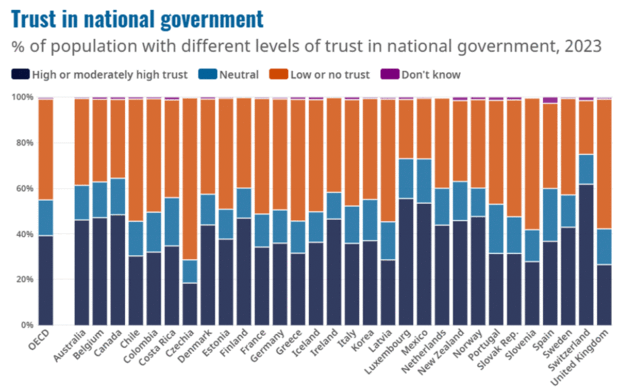
Trust really does matter - as has been well-argued elsewhere, trust is a critical pre-requisite for nearly all policy (and thus government) effectiveness.[4] A certain amount of trust in government is required if you want people to pay taxes, obey the law or use services responsibly. Trust is a ‘public good’ from which nearly all policies benefit from and would suffer without.
The critical role of listening for trust in government
Listening properly to citizens and end-users not only leads to better designed policies, but also increases trust in government. Given trust in government is a public good for policy effectiveness, proper listening has unrivalled direct and indirect impacts on both policy effectiveness and trust in government, and is something all policymakers should consider an essential objective in their work.
Many of the Public Policy Design Blog’s other posts demonstrate the impact of proper engagement and listening on policy effectiveness. For those that doubt the direct impact of listening to citizens on trust in government, there is a wealth of empirical evidence that demonstrates it.
One recent international study suggests that listening and acting on citizens’ concerns is the most significant driver of trust in government.[5] OECD analysis of data from 30 countries show that feeling listened to by government is more important than demographic and socio-economic factors for trust in government.[6] This holds in the UK, where the gap in trust in government is most strongly associated with the belief that the system allows people to have a say,[7] and is corroborated by data from the UK’s trust in government survey, in which 49% of UK adults report that engaging citizens is a contributing factor to their trust in government.[8]
Are policymakers listening?
There are brilliant and innovative examples of policymakers listening to the citizens and end-users who their policies affect - many captured elsewhere on this blog. But there are three reasons why this is not sufficient for the challenge outlined above.
First, these examples are often from more ‘downstream’ policymaking settings - where there is naturally a greater focus on implementation and delivery mechanics. At this stage policymakers’ hands are tied by the strategic direction already set - and that strategic direction has often been set by upstream policymakers who have not done enough listening to citizens to pre-empt and consider these challenges.
Second, the types of listening often done in ‘upstream’ policymaking settings could be much improved. Too often it is influential campaigning groups or other policymakers being listened to, rather than the end-users and citizens directly affected. Communities of policymakers and contacts with relevant organisations are clearly valuable to policymakers, but are no substitute to direct listening and engagement.
Third, even if policymakers think they are listening, the public do not. The increasing sense that the government is disconnected and ambivalent to ordinary people’s lives is something we should all be concerned about. We must listen more, better and to the right people
Why aren’t policymakers listening?
Many people in our country don’t feel that their government is listening to them. More people than ever do not trust their government. The above shows that these two facts are deeply connected and of profound importance to anyone who wants to make effective policy. So why aren’t policymakers doing more to listen?
There are three principled objections I’ve frequently heard that I don’t think stand up to scrutiny...
Argument #1 runs along the lines of: only delivery-focussed departments and policymakers need to worry about listening directly to end-users - not me.
Response #1: if you never make a decision that affects people outside of government, you are doing something wrong. And if your decisions do affect the real world- however downstream - you can never fully appreciate how that decision will likely be felt without listening to the people affected
Argument #2: the voice of the people is channeled through election, Parliament and Ministers in our representative democracy, so there is no need for policymakers to listen directly to citizens.
Response #2: this argument confuses listening to citizens with direct democracy. Policymaking is increasingly complex, iterative and non-linear. Every day important decisions have to be made. How can that be done when one PM, one Minister, and even one political party or Parliament only has so much time? Policymaking officials can better align with the priorities of elected Ministers through listening to citizens directly.
Argument #3: this will collapse into government by focus group, or some sort of Big Brother dystopia.
Response #3: this is a criticism of poor imitations of proper citizen listening: where it is done tokenistically, inauthentically, cynically or without permission. To me this is instructive for how we should and shouldn’t go about listening to citizens, but not if we should listen in the first place.
What’s the real reason policymakers aren’t listening?
If the principled objections to citizen listening don’t hold up to scrutiny, what’s the real reason policymakers are not doing it more and better?
This is a question that would doubtless benefit from more thorough consideration and deep research. But I have an early hypothesis.
Authentic active listening takes time, energy, skill and other resources. In busy professional lives, policymakers work in trade-offs as their modus operandi. The question of practical importance is not: should I do more and better listening to citizens but instead do the incentives for listening to citizens outweigh the incentives to spending that time, energy and resources on other endeavours?
This trade-off can be exacerbated by the risks and challenges posed by listening directly to citizens. There is often an anxiety about what a policymaker should do with experiences or views that seem to contradict Ministerial direction, and how a civil servant can listen without being seen to take a public position.
My gut instinct is that, in this blunt trade-off of incentives, listening to citizens is often deprioritised. Meeting deadlines for PQs, briefings, subs, or keeping vociferous advocacy groups engaged has more immediate benefits to individual policymakers, even if the policy areas we work on are poorer as a result.
We need to change the incentive system to encourage rather than frustrate efforts to listen to citizens directly
How do we create incentives for better citizen listening?
...is the open question I want to leave with you.
Over the next few months I will be engaging with the practical barriers and opportunities for policymakers to listen better to citizens and end-users. My plan is to develop a proposal for how upstream policymaking settings can overcome these barriers to listen better.
So I want to hear your experiences of the barriers to listening directly to citizens and end-users and any ideas you have for how these can be overcome.
Please share your experiences in the comments section below!
In return, I promise to listen to your experiences and ideas. And I hope to return to this blog to share a plan for a better future, where policymakers listen better, more and to the right people.
[1] British Social Attitudes (BSA) data. National Centre for Social Research. (2024, 12 June).Trust and confidence in Britain’s system of government at record low. Retrieved 7 December 2025, from https://natcen.ac.uk/news/trust-and-confidence-britains-system-government-record-low
[2] Seyd, B. (2024, 13 June). Low trust in government might not be that dangerous. Retrieved 7 December 2025, from https://blogs.lse.ac.uk/politicsandpolicy/low-trust-in-government-isnt-that-important/
[3] OECD Survey on Drivers of Trust in Public Institutions -2024 Results: Building trust in a complex policy environment. OECD Publishing. https://doi.org/10.1787/9a20554b-en
[4] E.g. see https://www.economicsobservatory.com/does-public-trust-in-government-matter-for-effective-policy-making
[5] Devine, D., Valgarðsson, V., Jennings, W., Stoker, G., & Bunting, H. (2024). The causes of perceived government trustworthiness. Wiley. 10.1111/1475-6765.12742
[6] OECD. (2024). OECD Survey on Drivers of Trust in Public Institutions -2024 Results: Building trust in a complex policy environment. OECD Publishing. https://doi.org/10.1787/9a20554b-en
[7] OECD. (2024). OECD Survey on Drivers of Trust in Public Institutions -2024 Results: UK Notes
[8] Office for National Statistics. (2024, 1 March). Trust in government, UK: 2023. Retrieved 7 December 2025, from https://www.ons.gov.uk/peoplepopulationandcommunity/wellbeing/bulletins/trustingovernmentuk/2023
Join our community
We use this blog to talk about the work of the multidisciplinary policy design community. We share stories about our work, the thinking behind it and what policymaking might look like in the future. If you would like to read more, then please subscribe to this blog. If you work for the UK's government, then you can you join the policy design community. If you don't work for the UK government, then connect with us on social media at Design and Policy Network and subscribe here to be notified about our monthly speaker events to hear from influential design thought leaders and practitioners.