
Government intent and service delivery don’t always connect early enough, and even when they do, alignment can waver during delivery.
At the Public Design Conference (part of World Design Congress Design Safari) in September 2025, policy and design teams from the UK and Canada joined forces to explore this common challenge.
This post is part of a series about public design patterns. They are inspired by the Public Design Conference, and published between the Winter 2026 and Summer 2027. Read other posts in this series here.
We prototyped a pattern
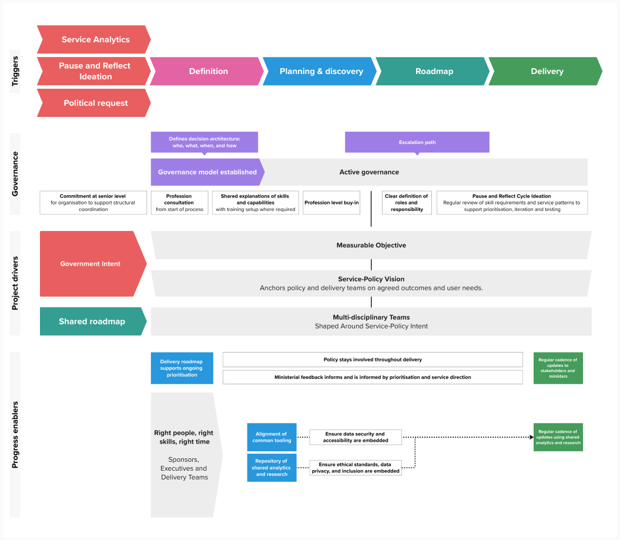
It’s based around a governance spine, a set of conditions and decision points that keep government intent, service design, and delivery aligned from start to finish.
The pattern has four main features:
- Governance spine: a clear decision architecture, escalation paths, and a “pause and reflect” cycle.
- Shared vision: a service–policy vision anchored in government intent and user needs.
- Multidisciplinary teams: outcome teams shaped around the intent, drawing in the right mix of policy, design, and operational expertise, at the right times.
- Enablers: shared roadmaps, research repositories, analytics, and principles like ethics and inclusion.
Why this mattered to us was simple: the governance spine gave structure without being rigid. It showed how intent and delivery could be aligned from the start, but also how policy could remain involved through delivery, avoiding the risks of disconnect created by “handovers”. The “pause and reflect” cycle also created space to regularly reassess and challenge assumptions before moving into solutions.
Crucially, when we refer to governance, we don’t mean more boards or paperwork. We mean the active conditions that enable collaboration: decision-making clarity, communication, and escalation when needed. These conditions are what keep teams aligned.
“Our prototype pattern: a governance spine supporting shared vision, multidisciplinary teams, and enablers — designed to keep government intent and delivery aligned.”
Adapted for different contexts
In the UK, government intent can sometimes be expressed to service and delivery teams through policy requests that arrive at pace. Service design and delivery teams can be brought in late, meaning user needs or delivery implications aren’t fully considered at the right moment.
In the Province of British Columbia’s Ministry of Environment and Parks, there is a dedicated Service Transformation team that ‘tags in’ on priority initiatives to help establish design-led approaches and digital ways of working. This creates opportunities for design and policy to fall into step - sometimes through direct partnerships with policy, and sometimes by embedding questions about policy architecture within design research. We have experimented with different forms of governance. This prototype helped us think about previous experiences and potential future iterations that can support design and delivery across the Ministry, with a focus on governance.
This pattern is helpful because it creates a structured flow: trigger → governance → shared vision → multidisciplinary team → enablers. It helps teams spot when and how to involve service design, and ensures a shared roadmap is in place from the beginning.
The challenge is often related to people's time, skills, and availability. Multidisciplinary teams can’t always mobilise at speed. That’s why the pattern is designed with flexibility in mind. For large reforms, the “full” version with structured governance points may be needed. For smaller policies, the “light” version — just a shared vision, a multidisciplinary team, and regular check-ins — may be enough.
Canadian colleague brought experiences from work in multiple Canadian jurisdictions and the UK. Together, we developed a pattern that resonated across our contexts. As a team, we sought to develop a pattern that could provide structure and flexibility.
In British Columbia, “government intent” is often used as an alternative to “policy intent” to signal how multiple teams - and multidisciplinary practitioners - work together to achieve a shared goal. We have found that the use of ‘policy intent’ can sometimes make this seem as something that belongs to policy practitioners alone. When government intent is the driver of service delivery, it facilitates the use of service analytics or operational pressures as a potential trigger for service design and transformation. By centering service analytics in the pattern, we could show how evidence can drive the same governance spine.
This emphasised the universality of the approach: whether the trigger is political, analytical, or operational, the same conditions for collaboration apply.
A pattern for international use
Flexibility and clarity were the two most important features. A pattern needs to be scalable: adaptable to the size of the challenge, and usable in both resource-rich and resource-stretched contexts.
The idea of a “full model” and a “light version” was particularly valuable. It gave colleagues from different nations confidence that they could apply the model without it becoming overwhelming.
Simplicity of visuals also matters. The shared diagrams and metaphors (like the “governance spine” and “muscles”) made it easier to communicate the model across contexts.
Finally, universal enablers such as analytics, ethics, and inclusivity give patterns international relevance. By focusing on outcomes for people and businesses, not just internal processes, patterns remain grounded in public value.
We also reflected on how the pattern could link to experiments like the Policy CoLab in the UK’s Department for Business & Trade. Embedding designers and researchers directly into policy teams is a live example of how some of these ideas can be tested in practice.
Patterns help designers collaborate across borders
We found that patterns help designers collaborate across borders …and in ways we hadn’t anticipated.
The collaboration process, sparked by participating in the conference. mirrored what we were trying to achieve in the pattern. Our initial workshops gave us shared direction and a vision. Afterwards, asynchronous working allowed individuals to take ownership, develop ideas in detail, and bring them back to the group for feedback. This gave us both depth and breadth, and reflected the flexibility of the pattern we were building.
The substance of our discussions also highlighted shared challenges. Whether in the UK or Canada, teams often face late alignment between intent and delivery, or lack clear governance structures to keep them in sync. Seeing these issues converge across systems and organisations gave us confidence that the problem and the pattern is universal.
The next step for us is to test. Each of us will explore how the governance spine could be applied in live projects, and how flexible models (full or light) might play out in practice. And we hope to keep the international dialogue open, so we can continue learning together.
Closing reflections
The Public Design Conference and its mini-conferences highlighted just how universal the challenge is of keeping government intent and delivery aligned. Every nation’s stories pointed to the same friction points: intent set in one place, delivery handled somewhere else, and the gaps that appear in between.
Our pattern showed that design shouldn’t be misconstrued as being solely about building or maintaining services at the end of a process, but about informing how government intent is translated into services people can use. It also showed how design can help make that intent more deliverable, by surfacing user needs and operational realities earlier.
The process was also a reminder of the value of working across borders. Different contexts sharpened our thinking, while similarities reassured us that we’re not alone in these challenges.
The impact of the exercise goes beyond a single prototype: it’s about building a shared language, simple tools, and the confidence to try new ways of connecting intent to delivery.
Join our community
We use this blog to talk about the work of the multidisciplinary policy design community. We share stories about our work, the thinking behind it and what policymaking might look like in the future. If you would like to read more, then please subscribe to this blog. If you work for the UK's government, then you can you join the policy design community. If you don't work for the UK government, then connect with us on social media at Design and Policy Network and subscribe here to be notified about our monthly speaker events to hear from influential design thought leaders and practitioners.
1 comment
Comment by Jayne Purcell posted on
I really like the re-framing to Government Intent. I'm also interested in then the link to organisational design linked to the architecture model and the capability model of the org's delivering.