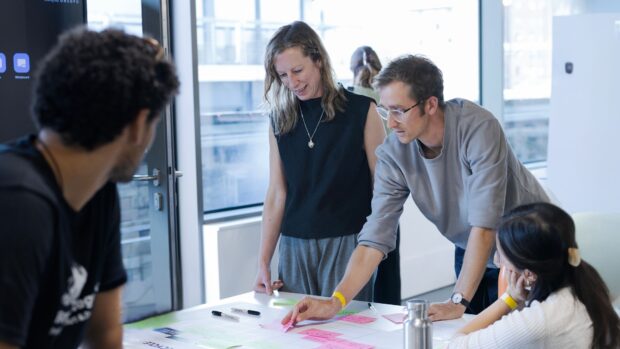
When international teams from Colombia, Canada, India, Peru, and the UK gathered for the Public Design Conference in September 2025, as part of the World Design Congress Design Safari, we found that we have common challenges.
‘Declining public trust, obstacles to civic participation, and communities feeling unheard
From the outset, we agreed that we needed to move beyond consultation towards genuine co-production, guided by the social model of disability and participatory design.
This post is part of a series about public design patterns. They are inspired by the Public Design Conference, and published between the Winter 2026 and Summer 2027. Read other posts in this series here.
Developing a pattern
Our international team was tasked to create a pattern for local places that could be used across the globe.
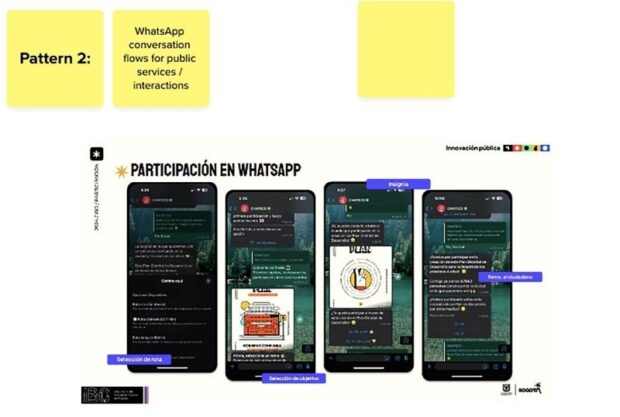
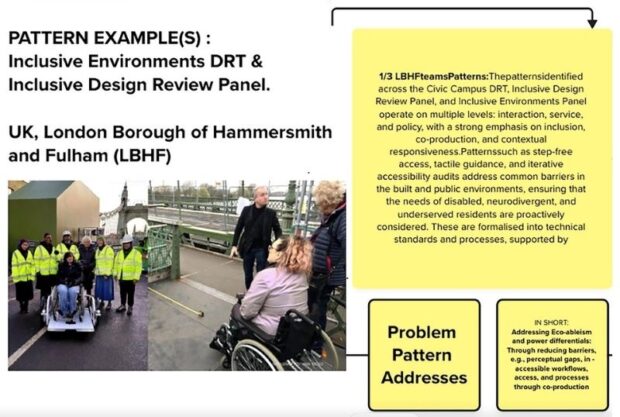
Building on insights from the London Borough of Hammersmith & Fulham Civic Campus Disabled Residents Team, and case studies like Bogotá's citizen response system, we created a one-page pattern framework for inclusive co-production. It is a modular, evidence-based template that any public body can adapt to share power with communities, promote agency, and develop policy and services with lived experience experts.
The pattern includes:
- Positioning users as co-producers, not passive recipients
- Providing training and ongoing opportunities so non-designers can influence and lead projects
- Closing the feedback loop so collaborators see the impact of their input
- Facilitating a gradual transfer of leadership and adaptation over time
Choosing a pattern
Shared motivations and regional needs drive the approach. Technical fixes alone are insufficient without cultural change in how governments involve people in design.
Across all countries, we observed barriers to access, representation, and agency for those furthest from power. Service Canada's client experience standards and Bogotá's civic labs both seek to democratise problem-solving.
Peru's context amplifies this urgency. Institutional trust is at historic lows, widening the divide between authorities and citizens. Services created from a disconnected perspective struggle to gain acceptance and are viewed as unsustainable. In this environment, inclusive co-production is not just one method among others; it is the essential path to lasting effectiveness and legitimacy.
Some places have begun to tackle these issues. At London Borough of Hammersmith & Fulham, disabled residents co-develop accessibility solutions for new public buildings. Its Inclusive Design Review Panel trains non-designers to participate in decision-making for the public realm and built environment.
In response, our approach to patterns addresses:
- Narrow consultation: the shift from isolated opinions to shared ownership
- Tick-box fatigue: to foster ongoing involvement with genuine impact
- Skills gaps: to enhance community members' abilities to lead, train, and develop future models
- Low trust: to practice transparency, with clearly define roles, and demonstrate how input influences outcomes
Testing the pattern
We examined where this pattern is making or could make a difference in real-world application:
- Understanding resident priorities: Camden Council's citizens' assemblies on health and climate have influenced policy in line with local realities.
- Deliberate inclusion: Decide Madrid and the Paris Climate Assembly foster open governance that includes diverse voices, which directly inform policy.
- Piloting before scaling: Although our pattern has not yet been tested in India and Peru, experience in both places emphasises the crucial need to pilot new programmes with community partners before expanding, showing that user adaptability and acceptance are vital for successful implementation.
The pattern is adaptable. In the UK, a social model, rights-based accessibility framework can conform to strict legal standards. In India or Peru, participatory practices must be adapted to different resources, informal power structures, and community norms.
When applying the pattern to older adults, service inaccessibility remains a common challenge in Peru and India. The pattern enhances practice at each stage:
- Discovery: surveys and consultations in community centres
- Co-design and co-production: structured discussions to develop solutions based on lived experience
- Implementation and monitoring: user-led groups and interviews to assess impact from their perspective, valuing lived voices alongside data and closing the feedback loop
Internationally usable patterns
Some features that would aid re-use across international borders have emerged from our workshops:
- Flexibility: open toolkits that can be adapted locally, exemplified by our ‘Swiss Army Knife’ style toolkit
- Clear guidance for adaptation: practical prompts rather than rigid checklists
- Participation and accessibility: prioritise local expertise and marginalised perspectives over a single best practice
- Transparent feedback and ownership: showcase contributions that lead to visible change, fostering skills for future leadership
We also recognise the limitations. Legal, cultural, and institutional factors are significant. Co-production may require more initial time and resources, but the long-term benefits in trust, legitimacy, and impact are considerable.
Three pillars for ongoing collaboration
The value of cross-government pattern sharing and aligning our processes have proved transformative. Sharing use cases, pitfalls, and adjustments across regions created a shared vocabulary and fostered mutual respect.
Patterns are not merely technical assets; they serve as cultural bridges that enable designers, policymakers, and residents to see themselves as part of an ongoing, adaptable collective effort. This dynamic approach allows contributors to build, teach, and refine patterns, promoting both sustainability and innovation.
We want to keep working with each other. So to sustain and expand this work internationally, we will concentrate on:
- Shared Platforms to provide replicable technical infrastructure
- Shared Terms to develop a common language for collaboration
- Shared Data and Dialogue to transform lessons into global public knowledge
This approach is essential for international contexts. For example, in Latin American contexts, it provides a practical way to rebuild public trust, leading to increased institutional legitimacy and acceptance among citizens.
By emphasising inclusive co-production and our three pillars, we aim to turn citizen distrust into a continuous and transparent model of global collaboration and co-production.
Contributors to this post
Angela Camargo, Innovacion Bogota, Colombia
Benny Souto, London Borough of Camden, UK
Daniel Murray, London Borough of Hammersmith and Fulham, UK
Esperanza Quispec, Pontificia Universidad Católica del Perú, Perú
Gigi Chang, Canada
Naoise Boyle, London Borough of Camden, UK
Natasha Trotman, London Borough of Hammersmith and Fulham, UK
Noel Hatch, Adur & Worthing Councils, UK
Ranjit Menon, India
S.Greet
Suzanne Iwai, London Borough of Hammersmith and Fulham, UK
Sydney Alexander, London Borough of Lambeth, UK
Further reading
Social model of disability and participatory design
Inclusion London overview of the social model of disability: https://www.inclusionlondon.org.uk/about-us/disability-in-london/social-model/the-social-model-of-disability-and-the-cultural-model-of-deafness/
UK examples and practice, Co-Production: Inclusive Design Review Panel, London Borough of Hammersmith & Fulham (LBHF): https://www.lbhf.gov.uk/councillors-and-democracy/resident-led-commissions/inclusive-design-review-panel
LBHF Civic Campus Disabled Residents Team: https://www.lbhf.gov.uk/councillors-and-democracy/co-production-doing-things-residents-not-residents/civic-campus-disabled-residents-team
LBHF Inclusive Environment Disabled Residents Team: https://www.lbhf.gov.uk/councillors-and-democracy/co-production-doing-things-residents-not-residents/inclusive-environment-disabled-residents-team
Citizens’ assemblies and deliberation in Camden: https://www.camden.gov.uk/health-and-care-citizens-assembly
International participation and civic tech examples:
Decide Madrid participatory platform: https://decide.madrid.es/
Paris Citizens’ Climate Convention and local climate assemblies, National Convention Citoyenne pour le Climat overview: https://www.conventioncitoyennepourleclimat.fr/
Bogotá citizen response and civic labs: Bogotá innovation lab and citizen engagement overview via city portals: https://centrogobiernolocal.gobiernobogota.gov.co/ and https://www.habitatbogota.gov.co/
Service Canada client experience and standards, Service Canada client experience and service improvement references:
Service Strategy and Client-First approach: https://www.canada.ca/en/employment-social-development/corporate/reports/service-strategy.html
Government of Canada Policy on Service and Digital: https://www.tbs-sct.canada.ca/pol/doc-eng.aspx?id=32601
Trust and legitimacy context, including Latin America and Peru, OECD trust data and insights: OECD Trust Survey summary and 2023 trust trends: https://www.oecd.org/governance/trust-in-government/
Latin America trust context and citizen confidence:
Latinobarómetro annual report: https://www.latinobarometro.org/lat.jsp
AmericasBarometer country briefs: https://www.vanderbilt.edu/lapop/
Peru institutional trust and legitimacy context:
Latinobarómetro Peru country series: https://www.latinobarometro.org/lat.jsp
OECD governance indicators and trust snapshots: https://www.oecd.org/gov/trust-in-government/
World Bank Worldwide Governance Indicators (interactive data access) for Peru: https://www.worldbank.org/en/publication/worldwide-governance-indicators/interactive-data-access
World Bank Worldwide overview for Peru:
https://www.worldbank.org/en/country/peru/overview
World Bank governance indicators:
https://www.worldbank.org/en/publication/worldwide-governance-indicators
Join our community
We use this blog to talk about the work of the multidisciplinary policy design community. We share stories about our work, the thinking behind it and what policymaking might look like in the future. If you would like to read more, then please subscribe to this blog. If you work for the UK's government, then you can you join the policy design community. If you don't work for the UK government, then connect with us on social media at Design and Policy Network and subscribe here to be notified about our monthly speaker events to hear from influential design thought leaders and practitioners.