
Perhaps you consider patterns as boring. When it comes to design in government, boring doesn’t mean dull or unimaginative. It means dependable, familiar, and safe. In public policy and service design, that’s exactly what we need more of. We need approaches that make it easier for people to use government services, and easier for teams to deliver them well.
Across government, teams are grappling with common challenges: tightening budgets, rising demand, and the people who use our services expecting digital services to “just work.” Amid these pressures, the real innovation isn’t about reinventing the wheel but about scaling what already works.
That’s where design patterns come in …reusable solutions to common problems.
This post is part of a series about public design patterns. They are inspired by the Public Design Conference, and published between the Winter 2026 and Summer 2027. Read other posts in this series here.
Enabling leaders to create better outcomes for citizens
Patterns don’t only deliver efficiency; they’re a leadership tool.
When leaders champion reuse and consistency, they’re signalling a commitment to value, trust, and delivery. They’re making it easier for teams across departments to learn from one another, and for citizens to experience government as one joined-up system rather than a maze of separate services.
When every government service looks and behaves differently, it’s confusing. Familiar patterns mean people can complete tasks more easily and confidently, even when moving between departments. They don’t notice consistency when it’s there, but they do when it’s missing.
Consistency means better accessibility by default. It means fewer mistakes. It means more time and energy for those who need extra support. In other words, it means better outcomes for everyone.
Consistency builds trust. People shouldn’t have to learn how to interact with government anew each time they need something. Familiarity gives confidence; confidence builds trust; and trust strengthens the legitimacy of public institutions.
So at its heart, this isn’t about systems or standards, but it’s about people.
Defining patterns
There is nothing new or wild about using patterns. A design pattern is a general, reusable solution to a common problem that occurs within a particular context. It’s not finished or perfect, but rather a template or blueprint that provides a starting point to help structure solutions in a consistent, proven way.
Simply put, patterns have been used for hundreds of years to improve consistency - the first mention I can find is from using patterns in planning and how we design physical infrastructure such as roundabouts - so it is very ‘tried and tested’.
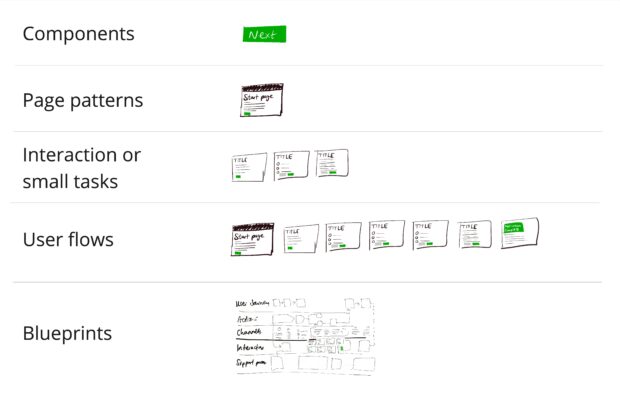
When we think of design patterns for digital, some of our designers at Wales’s Centre for Digital Public Services played with different levels of fidelity and have broken down the different types of patterns that might be used (…and we are still working out what each one should be called!):
- Component patterns: these are individual things we might use in a design, such as a button pattern or how we design radio buttons. The GOV.UK component library has tonnes of examples!
- Page patterns: how to show a specific page. These can be similar to the content patterns in the GOV.UK design system.
- Interaction or small tasks: these are the patterns that are called patterns in the GOV.UK design system and are more about interactions that can be designed to be consistent, such as how we design the way we collect repeatable information across different services—such as name, address, national insurance number etc.
- User flows: this is where we have started to dig into service patterns and have begun piecing together some of the patterns above into small user flows to explore whether there is scalable consistency for tasks such as booking something—whether that is booking a doctor’s appointment or booking a badminton court!
- Blueprints: we haven’t looked at this at all, but we assume this is the next level for patterns that look more across the end-to-end design of the service and improve consistency both front stage and backstage.
Patterns as a policy tool
What we are finding, across different parts of the public sector, is that service patterns in the form of user flows, can be used and applied in a wide range of contexts with confidence - we’ve already proven that in a fire service, a local authority, a sponsored body, and more.
User flow patterns (like apply, book, pay) are becoming the quiet superpower of design across policy and delivery. In Wales, we’ve been developing a library of service patterns to help teams build consistently high-quality services faster and more safely.
Now imagine applying that same principle to policy design itself. Patterns aren’t just a design concern. They’re a strategic policy opportunity.
Every time a policymaker designs a new intervention, they’re engaging with patterns, whether they realise it or not. Recognising and reusing proven ways of doing these things helps ensure policies can be implemented effectively, safely, and at scale.
Could we identify recurring “policy patterns”? Then, could we equip policymakers with tried-and-tested frameworks? Instead of starting from scratch, teams could focus on adapting what works to their context, informed by evidence and citizen experience.
Patterns help translate intent into reality. Patterns can become the connective tissue between policy intent, service delivery, and citizen outcomes.
Patterns are a multiplier for reform
Patterns may be quiet work, but they have loud effects. They enable scale, efficiency, and trust. They turn isolated good practice into shared capability. And they give policymakers the tools to design for delivery - not just in theory, but in practice.
In an era where public services must do more with less, patterns are not a constraint. They are a multiplier.
The future of government isn’t about one big reform, it’s about thousands of small, consistent, reusable patterns that make the system work better for everyone.
Want to explore or contribute to the Welsh Service Patterns Library? Stay up-to-date with our patterns work via our service patterns page or get in touch with the team to learn how patterns can help your policy or service deliver more with less.
Join our community
We use this blog to talk about the work of the multidisciplinary policy design community. We share stories about our work, the thinking behind it and what policymaking might look like in the future. If you would like to read more, then please subscribe to this blog. If you work for the UK's government, then you can you join the policy design community. If you don't work for the UK government, then connect with us on social media at Design and Policy Network and subscribe here to be notified about our monthly speaker events to hear from influential design thought leaders and practitioners.
1 comment
Comment by Dennis posted on
This was a really enlightening read! I love how the article doesn’t treat ‘patterns’ as mere data trends but shows them as powerful tools for understanding complex systems and crafting better policy. The clarity with which it explains how patterns help us see deeper connections made the topic feel accessible and relevant even to someone outside government or design fields. This gave me a new way of thinking about how repeated behaviours, decisions, and outcomes can actually guide better decision-making. Thoughtful and impressive work!