https://publicpolicydesign.blog.gov.uk/school/
Government School of Design
Britain founded the first Government School of Design in 1837 to strengthen national capability in industrial innovation. Nearly two centuries later, the same challenge re-emerges - this time not in factories, but inside government itself. The modern state must design policies and services that can adapt to complexity, meet diverse needs, and deliver public value at pace.
The Government School of Design relaunches this historic institution for a new era. Its mission is to make design literacy a core skill of governance - so that civil servants at every level can think, create, and deliver with users, evidence, and systems in mind.
You can read the school's prospectus to see the courses it offers.
The case for a national design institution
Across the world, governments are reforming to tackle “wicked” problems - issues such as ageing, inequality, digital transformation, and climate resilience that span departmental and sector boundaries. Traditional approaches based on single disciplines or linear policy cycles cannot cope with this interdependence.
Design provides a structured, evidence-led way of navigating complexity. It helps civil servants connect intent (policy ambition), systems (institutions, funding, and data), and people (citizens, users, and staff). Design capability allows government to move from describing problems to testing and delivering solutions in real conditions.
The Government School of Design reduces public risk by embedding design as a permanent function of the state. Its purpose is threefold:
- Build capability by teaching and accrediting a curriculum grounded in the seven Universal Public Design Practices.
- Improve ‘real world’ outcomes for citizens and taxpayers by focusing on value creation, not activity.
- Leverage multidisciplinary collaboration by joining-up policy and delivery and using an end-to-end design framework for making public services.
The school is a joint initiative of government design communities (and their professions) and national design institutions.
Its long-term mission is to ensure that design becomes a recognised and rewarded capability within the Civil Service - creating a modern, adaptive, and value-driven government.

The profession: what is public design?
Design is one of the humanity’s oldest skills. Everyone casually designs things in their day-to-day lives. But there is also a technical way of designing that is used by professional designers.
- Designers who make public policies and services and spaces are named public designers.
- Public design is the practice of making things with and for people within the context of the complex world in which they live and work.
- Public design is an approach that produces public value and de-risks public investment.
- Public design is both a technical design process and also a set of technical design practices that are deployed at each stage.
In Summer 2025, UK Civil Service published a ground-breaking report on role and value of design in the public sector: the Public Design Evidence Review.
The challenge: a capability gap in government
Public services face rising complexity, fiscal pressure, and expectations for quality and responsiveness. Yet the UK government’s internal design capability remains fragmented and uneven.
Evidence from the Public Design Evidence Review and the National Audit Office highlights the issue clearly:
- Roughly 31,000 people perform design-related work across the public sector - from policy design to service design to communication design.
- Two-in-three designers have no formal training, qualification, or clear career path.
- Different design professionals use different standards and terminologies, leading to duplication of effort.
- Policy and delivery teams often lack the tools to understand user behaviour or system dynamics, resulting in unintended consequences.
The result is avoidable risk and variable performance. Projects reinvent design methods, recruit inconsistently, and struggle to demonstrate return on investment. When design practice is dispersed and unrecognised, innovation becomes personality-driven rather than systematic.
New design infrastructure can close this gap by setting standards, building capability, and proving the public value of design. Without it, design in government will continue to depend on local enthusiasm rather than national strategy.

The opportunity: re-launching a national institution
In 1837, the first Government School of Design helped Britain compete in industrial production. In 2026, the Government School of Design performs the same function for public administration - helping the UK improve institutional productivity and deliver more meaningful outcomes for citizens.
The opportunity is both symbolic and practical. By relaunching the school, Civil Service signals that design is no longer a niche craft but a core skill for delivering public policies and services. The school contributes to Civil Service reforms on: re-deploying 1-in-10 staff to digital, regional campuses, test-learn-and-grow, missions, and government skills.
Public design strengthens government’s performance through three levers:
- Public value creation – using design methods to transform public investment into outcomes that improve productivity and citizen wellbeing.
- Risk reduction – testing ideas with users and delivery partners before full implementation, avoiding costly policy failure.
- Multidisciplinary expertism – enabling professions - policy, digital, operations - to work through a common language and architecture that joins-up policy and delivery.
The school institutionalises these levers. It provides the structure, accreditation, and learning culture to make design a repeatable part of government’s operating model rather than an isolated innovation.
Proven practice: design is already delivering public value
Design in government is not hypothetical; it is already producing results. The Public Design Evidence Review showcased case studies from across Whitehall and local authorities. Three illustrate the power of design in practice:
- DWP Design Science Team – applied ethnographic research and prototyping to benefit-claim processes.
Result: faster processing times, fewer errors, and improved claimant experience. - Teacher services redesign (DfE) – unified digital and policy teams to simplify recruitment and retention services for teachers.
Result: measurable efficiency gains and higher user satisfaction. - Shared Outcomes Fund pilots – cross-departmental design teams created joined-up approaches to homelessness and youth employment.
Result: stronger collaboration and clearer accountability for outcomes.
These projects demonstrate how design reduces cost and risk while improving citizen outcomes. The Public Design Evidence Review provides the empirical base for the school’s creation: an institution to scale proven methods across government.
Our offer: design for all
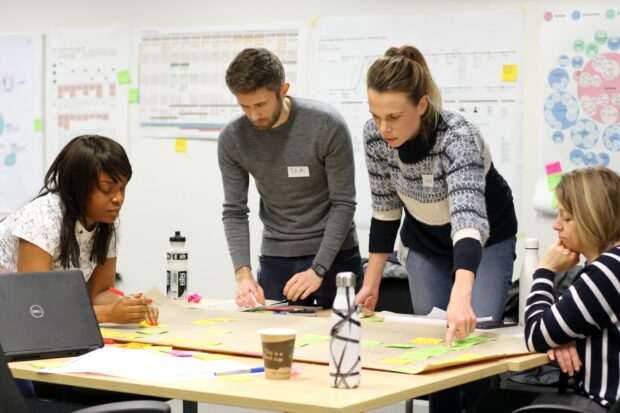
The school provides design training for all civil servants whether they are designers – non-designers – or even future designers. There is something for everyone who wants to make policies and services in way that delivers better public value.
The school is integrated with Civil Service Learning and Government Campus, and has an offer for three audiences:
Design for everyone – we offer a bite-sized 1-day courses including our introduction to design, and an activity-based hackathon to try some design techniques. Our flagship Policy-to-Delivery Course (aimed at mid-career professionals of all types) provides 5-days of immersive multidisciplinary training - hundreds of officials have already graduated, and it is the highest-rated course in Civil Service.
Design for leaders - the school offers training for Senior Civil Servants to boost understanding design’s impact on public outcomes and leadership efficacy and how to lead design work.
Design for designers – our technical training offer is for existing or new designers. We offer up to 300-hours of applied and accredited learning on universal public design practices, and a framework to level-up your skills to prestige Chartered Designer status. Our work-based learning model is underpinned by designers teaching designers.
You can read the school's prospectus to see the courses it offers.
Career development: the journey of a public designer
The school provides a clear, portable career pathway for every public-sector designer - from entry-level practitioner to chartered professional. Designers will be awarded qualifications and be able to formally state their chartered status after their name. This mirrors professional models in engineering and accountancy, giving design parity of esteem within the Civil Service.
Professional Pathway
- Junior designer (Level 4): Appr.CSD
- Designer (Level 6): aCSDm
- Senior designer: MCSD / Chartered Designer
Accredited foundation curriculum
There are seven universal public design practices for all public designers:
- Understand the problem
- Make sense of evidence
- Communicate insights and ideas
- Create options for change
- Prototype, test, learn, and adapt
- Engage people to produce better policies and services
- Share and reuse what works
Specialist tracks
For deeper expertise, specialist designers (like policy designers, service designers, interaction designers, etc) can pursue specialist modules (like futures, blueprinting or digital UX tools) through partner institutions.
Partnerships: a whole-of-Civil Service initiative
The school operates as a joint venture across the entire design pipeline of government.
Civil Service partners
- Policy Design Community (via heads of policy design, who are an expert community of practice of Policy Profession)
- Digital, Data and Technology Profession (via heads of service design)
- Operational Delivery Profession (partner in delivering their fast stream graduate offer)
- Cross-Gov Creators Network and the Creative & Production Leaders Group (hosted by Government Communication Service).
External partners
- Chartered Society of Designers – verifies professional qualification and provides and chartership pathways.
- Design Council – research and capability development partner
- UK design schools and universities – design research partners include Royal College of Art, UAL Central Saint Martins, UCL Institute for Innovation and Public Purpose, University of Manchester.
- Arts and Humanities Research Council – funded design research that underpins the school model
- Design institutions – Royal Society of Arts and Nesta have played a role in establishing the school.
- UCL Institute of Education – provided pedagogical advice on professional learning research.
Governance and hosting
- Operated by the Policy Design Community Board (including heads of service design) and hosted by the Department for Education
- Financially self-sustaining by 2027 through cost recovery and partnership funding.
This sustainable partnership model ensures credibility, breadth, and collective ownership across Civil Service, and forges ties between design practitioners and design researchers.
Impact: what the school delivers
For departments
- Reduces programme failure by joining-up policy and delivery, and securing user insight early.
- Provides consistent professional standards, simplifying recruitment and procurement.
- Demonstrates return on investment through evidence of improved outcomes and efficiencies.
For civil servants
- Creates visible career routes and qualifications recognised across government.
- Builds practical skills to navigate complexity and deliver change.
- Fosters a professional identity and community of practice linking designers across disciplines.
For government as a system
- Establishes a coherent framework for design capability, curriculum, and accreditation.
- Supports wider Civil Service reform by embedding design literacy into leadership and training.
- Enables continuous evaluation and benchmarking aligned to the Public Value Framework.
For citizens
- Policies and services that work first time because they are built around real user needs.
- More transparent, responsive, and trusted public institutions.
- Design provides the missing connective tissue between intent and impact - transforming public investment into measurable public value.
Public design produces public value:
The cost of designers and implementing design < public service delivery costs avoided and saved + citizen wellbeing

Legacy: establishing design as a core function of the state
The UK already has a global reputation for its use of design to innovate – including through the digitisation of its Victorian public services over the past 10-years. Now the relaunch of the Government School of Design extends the UK’s heritage of design education and brings it into public administration.
This will enable the Civil Service to position itself at the vanguard of design for public administrations alongside other innovative organisations like Danish Design Council, Singapore’s GovTech Design, Impact Canada, and Taiwan’s Ministry of Digital Affairs, and OECD Observatory of Public Sector Innovation.
The legacy is more than a school: it is a permanent institution that strengthens the capability of the Civil Service to govern complex systems, design fair policy, and deliver value for citizens - continuing the tradition of public purpose through design.
Further information
You can read the school's prospectus to see the courses it offers and book your place here.
For more information, or if you need consultancy support or a bespoke design capability service, then contact the Head of School, Andrew Knight, on andrew.knight@policyprofession.gov.uk.