
Over the summer, a group of design and policy practitioners from around the world came together to share ideas, compare approaches, and spot patterns in how we work. The goal? To learn from each other and build something useful for the wider design and government community.
All the participants worked in “cross-gov” teams...units, labs, departments that work tangentially across a range of different topics and policy areas, not defined by one unique topic, or focus area. We had participants from: Policy Lab in the UK government, EU Policy Lab in the European Commission, US Government, Scottish Government, Experio Lab in Sweden, and Services Australia.
Common ways of designing policy
Collaborating across multiple countries, disciplines, and levels of government exposed both the opportunities and the challenges of working in diverse teams.
We found differences in terminology, local practices, policy frameworks, yet at the same time, this diversity proved to be a strength. It allowed us to see familiar challenges from new angles, surface hidden assumptions, and raise questions on whether patterns we take for granted in one context hold true elsewhere.
By navigating these differences and discussions, we not only deepened our understanding of policy design in practice but also built the foundations for stronger cross-border collaboration.
We use different terms, sit in different structures, and respond to different political cycles. Yet when we looked underneath that, we found we are often wrestling with the same issues: how to involve people meaningfully, how to work across silos, how to turn learning into long-term change.
We uncovered some powerful common threads: shared patterns, tensions, and building blocks that seem to show-up across our work.
Patterns for approaching policy design
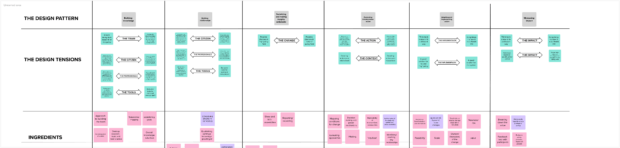
We identified five core patterns in policy design work:
- Building knowledge: Gathering evidence, mapping systems, and understanding the context, so insights are grounded and can inform meaningful decisions not only for the design team but for all the key actors that will apply the work.
- Building relationships: Establishing trust and connections among stakeholders to navigate tensions and enable collaborative action. Engage the people who influence or are influenced by the work as partners including internal experts across disciplines and people with lived experience in using or delivering a service.
- Socialising and making insights actionable: Communicating insights effectively and translate them into practical steps, ensuring that learning informs decisions and is shared with the right audiences.
- Generating transformative action: Identifying opportunities for systemic change, addressing tensions creatively, and driving initiatives that can shift practices and outcomes not only of immediate actions but of future-proof and -informed ambitious initiatives.
- Adopting and implementing action: Turning solutions into policies, structures, and processes, ensuring that design interventions are truly embedded to have lasting impact.
Case study: tackling water reuse in the EU
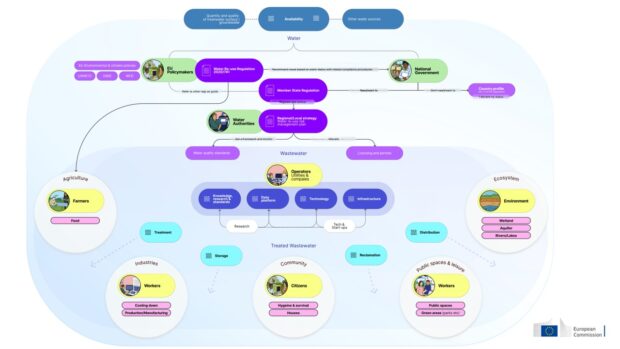
An example of how these patterns show up in real life is from one of the participants, from the EU Policy Lab of the European Commission. The project aimed at addressing Europe’s growing water challenges, with a particular focus on water reuse. Using a participatory, mixed-methods approach, it builds knowledge through system mapping, scenarios, workshops, and behavioural testing, identifying areas for coordinated action, including pricing, governance, and infrastructure. The project builds relationships among policymakers and scientists from different departments, experts across private-public sectors, and local players to create a shared understanding of the challenges and efforts. By engaging all these actors from across the system in the design of interventions, the project ensures that insights are socialised and made actionable, with initiatives like pilot projects and systemic interventions. To generate transformative action, the project advocates for a centralised/decentralised hybrid systems where new governance structures and behavioural incentives could shift current efforts for long-term visions. The project does also emphasise the importance of adopting and implementing these solutions by embedding them into future EU policy reviews.
Tensions to navigate
Tensions are the push and pull between different priorities, values, or approaches that shape how policy design works in context. They are not necessarily problems to be solved, but dynamic forces that need to be balanced or acknowledged as they represent possible trade-offs, negotiation, and reflection that are needed to make progress.
By analysing, materialising, and exploring these tensions, we gain a deeper understanding of how design patterns operate in real-life policy contexts and what it takes to navigate complexity.
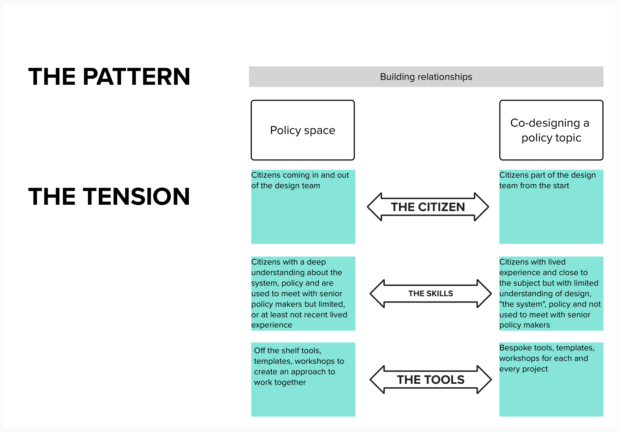
For instance, when thinking about how citizens might participate in a policy design project, the “building relationships” pattern becomes especially important. What is the ask of people with lived experience of accessing and delivering services in terms of their involvement? Are they dipping in and out of the design process, or are they embedded in the team from start to finish? What is feasible, ideal and practical came up as key elements of tensions that bring you to one or the opposite side of that scale.
This helps you consider what kinds of training and support might be needed to prepare and empower people to be part of the design process across policy teams. When moving into a co-design space, the emphasis should be on understanding where decision-making can be shared and learned together. More time will be required for upskilling and capacity-building, and strong relationships will be needed to work together on challenging or potentially sensitive areas of decision-making.
The toolkit for design projects will also vary depending on the context. Where you are co-designing a policy topic, crossing organisational boundaries, you may need to develop a bespoke design process, with time and effort up front on creating the system conditions. That may involve agreeing to new governance arrangements to support strong collaboration and senior level sponsorship to ensure the vision and goals of the work are well understood and prioritised.
Building blocks to drive outcomes
Across our discussions we also surfaced some of the practical ingredients that make these patterns work in real projects. These include:
- Time and space for sense-making, not just delivery, so that we can understand the system before we intervene
- People who can bridge across disciplines and departments, translating between policy, operations, data, and lived experience.
- Lightweight governance that gives permission to experiment while keeping sight of core public outcomes.
- Simple artefacts – diagrams, stories, prototypes – that make complexity visible and help others act on the insights
We see these building blocks as reusable components. They can be assembled differently in each context, but they help turn abstract patterns into real shifts in how governments work with and for people.
So, what’s next?
By naming common patterns, tensions, and building blocks, we start to create a shared language for this work. That matters because:
- Value in creating common language. It helped us realise we are often working with the same building blocks, even if we call them different things.
- Value to convening as a peer group. We have built new relationships and networks that stretch across countries.
- Value in working asynchronously ...and we are keen to keep improving how we do it.
- Reduces duplication. Teams in different places do not have to start from scratch every time; they can build from what others have learned.
- Makes invisible work visible. Much of design and policy work is relational and experimental. Patterns help describe that work clearly so colleagues, leaders, and partners can see its value.
- Strengthens the case for investment. When similar patterns show up across governments, it becomes easier to argue for sustained capability in design, participation, and systems thinking.
- Keeps the focus on outcomes for people. Patterns link our methods to what changes for citizens, rather than to internal processes or tools.
For us, the real value is not a perfect taxonomy. It is having a living, shared map of how design and policy can work together in practice. That map helps new colleagues orient themselves, helps leaders understand what they are commissioning, and helps us all move faster towards better outcomes for people and planet.
We can build on what we have started by continuing to share knowledge, deepening our understanding of design in different policy contexts.
With more resources, we could…
Keep the pattern library alive - To maintain a simple, shared working document that describes each pattern, the tensions around it, and the building blocks it needs. We will test these in our own projects and update them with concrete examples, citizen outcomes, and what it took to get there.
Share what we learn on a regular rhythm - Every quarter, we could collect short, plain-language notes from our teams on where the patterns have helped, where they have fallen short, and what has surprised us. We will use these to spot new patterns, retire ones that are not useful, and sharpen the language so it stays accessible.
Learn together through focused sessions - Host online workshops, rotating between organisations. In each session we will bring one or two live cases, map the patterns and tensions at play, and reflect on the building blocks that made progress possible. These sessions will act as a peer support space for people working in complex, cross-cutting areas.
Build a shared view of where work is happening - Map live and upcoming work against the patterns and key themes, creating a simple “dashboard” of activity. This will help us see where similar challenges are being tackled in different places, where collaboration could add value, and where there are gaps that need attention.
Create an accessible repository - Over time, we could curate an open, easy-to-navigate repository of examples: short case stories, tools, visuals, and templates linked to each pattern. The aim is to make it useful for busy policy officials, commissioners, and practitioners who want to try a different way of working but are not design specialists.
The value in developing this further is straightforward.
A shared pattern language and evidence base can help governments everywhere design better policies and services, faster, with and for the people affected.
It gives us a way to connect local experiments to global learning, and to turn individual projects into a growing, collective capability for public problem-solving.
Join our community
We use this blog to talk about the work of the multidisciplinary policy design community. We share stories about our work, the thinking behind it and what policymaking might look like in the future. If you would like to read more, then please subscribe to this blog. If you work for the UK's government, then you can you join the policy design community. If you don't work for the UK government, then connect with us on social media at Design and Policy Network and subscribe here to be notified about our monthly speaker events to hear from influential design thought leaders and practitioners.
Leave a comment